Sunday, April 29, 2012

"I Am Providence" - Reflecting on the Legacy of H.P. Lovecraft (or lack thereof)

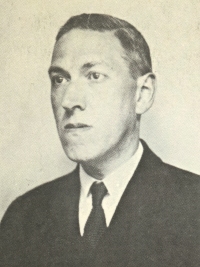
Phillip Eil's feature on H.P Lovecraft this week in the Providence Phoenix poses the question -- are Rhode Islanders finally ready to recognize Providence-born H.P. Lovecraft's legacy as a horror writing hero? Given Lovecraft's contribution to the genres of science fiction and horror, his affinity for New England in general and Providence in particular, it's odd that Providence (a city which since the 1990s prides itself for its attention to culture and the arts) has done...not much in promoting itself as Lovecraft's hometown. Eil's article points out that beyond Lovecraft's grave site (right) and a plaque at the John Hay Museum (quoted below), there are no other memorials to Lovecraft anywhere in Providence. Edgar Allen Poe, Walt Whitman, Jack Kerouac, even Robert E. Howard and Zane Grey are among the long list of literary figures that have museums or houses devoted to their memory. It is time to establish a similar historical institution devoted to H.P. Lovecraft. I argue that if such a museum were to be founded anywhere on Earth (other than beyond a nameless mountain range in Antarctica), it should be in Providence, Rhode Island.

The dearth of a official plaudits is not for lack of local enthusiasm for Lovecraft. Donovan Loucks, who operates the extensive (and award-winning) website, The H.P. Lovecraft Archive, has identified all the relevant Lovecraftian sites in Providence and a walking tour designed to take aficionados to see them.

For a few years local fans also ran the aptly named NecronomiCon, but it fizzled when the organizers apparently burned out after running the Lovecraft memorial every odd-numbered year from 1993 through 2001. Lovecraft's birthday is still celebrated annually with visits to the Ladd Observatory and graveside readings by Lovecraft stalwarts.
I never can be tied to raw, new things,
For I first saw the light in an old town,
Where from my window huddled roofs sloped down
To a quaint harbour rich with visionings.

Streets with carved doorways where the sunset beams
Flooded old fanlights and small window-panes,
And Georgian steeples topped with gilded vanes—
These were the sights that shaped my childhood dreams.

                        - H.P. Lovecraft, XXX. Background, Fungi from Yuggoth                         (Appears on Lovecraft's Memorial Plaque, John Hay Library, Providence RI)

Lovecraft clearly loved the old colonial architecture of Providence's East Side, aptly described here in a poem that was otherwise an ode to fungus on a gigantic trans-Neptunian world. At right is the house on Angell Street in Providence where Howard Phillips Lovecraft was born in 1890 (image from The H.P. Lovecraft Archive). What a beautiful old Victorian house! Unfortunately it was torn down in 1961 -- it would have been perfect for a Lovecraft museum . Luckily there are many other locations with a "Lovecraft" connection in Providence. It is time for a concerted effort to establish a an H.P. Lovecraft museum or house in Providence, preferably somewhere connected to his life or his writing, if that is possible. I think there is sufficient interest to support a Lovecraft museum from the "sci-fi and horror communities" and knowledgeable tourists looking for something interesting to see while in Providence. Given the current state of the real estate market, there will never be a better time to move forward with such a project.

I also think that along with celebrating the originality, the brilliant eccentricity of Lovecraft's writing, that the numerous criticisms leveled at him should be part of the exhibit as well. While some might argue against celebrating the work of someone who was clearly as racist as Lovecraft, presenting Lovecraft's less savory aspects in the context of his times should be part and parcel of the exhibit. America at the time of Lovecraft's writings was easily as racist as he was, nor was antisemitism confined only to Nazi Germany. Attitudes toward the aboriginal peoples around the world (with the exception of anthropologists and a few enlightened missionaries) mirrored Lovecraft's label of "savages." These aspects of his writings and personal beliefs are just as important to providing a complete picture of Lovecraft and early 20th century America, just as the inclusion of Sally Hemings at Monticello is vital to the understanding of Thomas Jefferson and the late 18th century. Lovecraft's foibles provide a "teachable moment" for those visitors who come because they wanted to visit the museum for the author of the "Cthulhu Mythos," but when they would leave they would have an increased understanding of what America was like 75 to 100 years ago, and how far it has come since then.

That others find his writing sophomoric should not inhibit our efforts to establish a serious institution devoted to Lovecraft either -- haters gonna hate. Even as Lovecraft biographer L. Sprague de Camp described Lovecraft's prose as "turgid, verbose, and overwritten," it was a far more charitable assessment than what Colin Wilson and other critics had to say of Lovecraft's stylings of the otherworldly. But despite numerous naysayers, H.P. Lovecraft has had an indisputable impact on modern media and popular culture -- from the movie Alien to Stephen King and Clive Barker to Metallica and even French philosophers -- promoting Lovecraft as a favorite son can only have a positive multiplier affect on the cultural cachet of the capital city.

In a state where some residents were half-serious when they proposed that the Big Blue Bug represent the Rhode Island on the state's quarter, it's time for Howard Phillips Lovecraft to take his rightful place as a literary icon of the state.

But the stream of Time, swift flowing,
Brings the torment of half-knowing --
Dimly rushing, blindly going
      Past the never-trodden lea...

-excerpt from "Despair", poem by H.P. Lovecraft (February 1919)


Lest we fall into despair at the horror of our past...

(image of a not-so-invisible whistling octopus after all from cryhavoc.org)

Sunday, April 15, 2012

The Mill Seat at Woodville - Vestiges of a "Liminal Village"

One recently overcast day, I clambered over a guardrail and over a quite rickety foot bridge in Woodville, RI and took some up-close pictures of the former mill seat there. This site is on my list of southern Rhode Island's "liminal villages" -- communities that straddle the border of two towns separated by a river, usually centered on a textile mill. Like the mill villages at Potter Hill, Burdickville, Usquepaug, Bradford, Alton, and Kenyon, the textile mill was located in one town while much of the mill housing was built across the river in the other. In the case of Woodville, the mill seat and (what was likely) the local store, tavern, and owner's house was in Richmond (see below) while much of the worker's housing was in Hopkinton.

Here are two photos I took of the mill seat late in the summer of 2007, when the Wood River was as low as I've ever seen it. On the right (or north) bank of the Wood River is Richmond; the left (or south) bank is Hopkinton. And yes, that is a goat grazing amongst the mill ruins all the way to the right. Some of the old gears are still plainly visible through the foliage in this photo from 2007 (below).
Based on the series of "For Sale" signs along the road in Richmond leading up to the Woodville Bridge, the entire corner (including mill seat, the old store, the owners house, and several other structures that make up the former mill compound) are currently up for sale. I decided then to stop and get a closer look of the ruins before any new owners come along and clear the old mill away...

Historically, these locales had been divided in the colonial era when the state of transportation made attending town meetings on the other side of swollen, icy rivers inconvenient and even dangerous. Colonial town records suggest that the bridges of the day were precarious and frequently damaged or destroyed in floods. These locations were often the seat for grist or snuff mills, and were only sparsely populated.

Prior to King Phillip's War, Rhode Island's towns were quite large (see map at left, Rhode Island Town's, 1675). Kingstown for instance encompassed an area of 240 square miles, and originally consisted of the present-day towns of East Greenwich, West Greenwich, Exeter, Narragansett, North Kingstown and South Kingstown. The white population, by contrast, was quite small; by 1670 Rhode Island's entire European population has been estimated at slightly over 2100. The majority of Rhode Islanders at that time lived in a handful of villages and settlements that hugged the coastline of the tiny colony. When Rhode Island finally held its first census in 1708, the number of residents had increased to to 7100; by 1730 that number had increased to 17,000 (see Census of Rhode Island, 1865).

The process of carving smaller towns from the two large towns that made up the King's Province began in 1722/23, when residents in the southern section of Kingstown petitioned the General Assembly to partition the town so they might more easily attend to public business. The General Assembly tabled the petition for a session to allow Kingstown's northern residents to respond. But despite complaints from the residents of Wickford, the General Assembly replied that Kingstown was “very large and full of people so that it is convenient for the ease of inhabitants and dispatching business to divide the town” (see RI Laws 1730, page 126). In the spring of 1723, South Kingstown was taken from Kingstown and what was left became North Kingstown--which was allowed to keep Kingstown's original founding date as its own. (see map King's County, 1757, below)

This procedure set the precedent for creating new towns from old in Rhode Island. Twenty years later, residents from the western section of North Kingstown as also complained that it was difficult to get to town meetings in Wickford; in March 1742/43 the General Assembly created the town of Exeter.

Westerly was similarly carved up beginning in 1738. The eastern half of Westerly was divided into Charlestown at the Wood and Pawcatuck Rivers; a few years later the section of Charlestown north of the Pawcatuck petitioned to become Richmond when "evil minded men" from the plantation area along the coast "carried our meeting several miles from the center which we agreed upon" (Petitions to the General Assembly, Vol. VI, document 145). A decade later residents of northern Westerly petitioned to be divided at the Pawcatuck and became Hopkinton (which was separated from Richmond at the Wood River at what would become Woodville). The division of Westerly clearly illustrates the dilemma geographic barriers presented to remote members of the body politic. With the exception of the boundary between Westerly and Charlestown, every other division followed the contours of a river.


West Greenwich was similarly formed by petition in 1741, though East Greenwich was a special case. In the aftermath of King Phillip's War, the General Assembly set aside the northern section of the King's Province "for the accomdatinge of soe many of the inhabitants of this Collony as stand in need of land” -- which became the town of East Greenwich. (Bartlett, Rhode Island Colony Records, Volume II, pages 587-88). Since Kingstown was not a functioning town at the time (despite it's creation by the General Assembly in 1674), no one from there complained when East Greenwich was removed from its jurisdiction. In 1729 when the Rhode Island's county judicial system was established, East Greenwich was made part of Providence County. In 1750 it became the county seat of the newly formed Kent County.

Later, in the early decades of the 19th century, the grist and snuff mills at these river crossings were bought out by local entrepreneurs to build the first water-powered textile mills. What factors went into deciding which town the mill proper was to be built? Why was most of the mill housing often built in the town "across the bridge?" How for instance did residents decide where to build the local church? What attracted workers to settle in one mill village rather than another? How permanent or transient was the workforce? These questions for now remain unanswered. Answers to other questions about these liminal villages can be derived from what is generally known about 19th century American society. How was it resolved which town got the village post office? After the election of Andrew Jackson, the so-called spoils system determined the location of the federal post. In years that a Democrat was President, the post office was likely located in the business or home of a stalwart Democrat; when the nation had a Republican (or Whig) President, the post office was relocated to the shop of a similarly suitable partisan. Woodville's post office was established in 1853, and was closed down in 1925 (see R.I.H.S. Postal History), which provides us with some indication of the heyday for this particular mill seat. As for the taverns, their location was determined once the temperance movement began in earnest in the 1840s. If one side of the village "went dry," a grog shop would simply reopen on the other side of the village across the river, so long as liquor licenses might still be had there. Even if the town wasn't dry, town councils shared information with neighboring councils about "common drunks" who had been "posted" or banned from being sold alcohol within the town limits, so they would not simply carry on their dissipation in the next town over. In a liminal village like Woodville, the Hopkinton town clerk had only to cross the bridge to put the notice on the tavern door in Richmond to shut off the local tosspots.

To date, there has been little scholarly research done on the village at Woodville. The Rhode Island Historical Preservation Society conducted a preliminary survey of Hopkinton in 1976. A brief entry for Woodville Historic District notes only that it was:
A small settlement along both sides of Wood River, extending into the town of Richmond. There remains today in Hopkinton a group of five residences dating from the middle-to-late nineteenth century. One has been maintained; the other four are deteriorating. To the west are several other dwellings associated with the community, and an undistinguished mill is located along the nearby river. About 1666, when the area was part of Westerly, James Babcock, began the manufacture of iron and continued until his death in 1698; the business subsequently continued in operation as the "Lower Iron Works." In the 19th century the textile industry was introduced to Woodville. (1870 - Woodville, Woolen Mill, and several buildings.) (page 18)
But seeing as this is a liminal village, the Rhode Island Historical Preservation Society's survey for Richmond, conducted in 1977, also reported on Woodville. It is somewhat more informative:
At Woodville (13), several miles downstream [from Hope Valley], a gristmill was established on the Richmond side in the eighteenth century. Later, Simeon Perry built a gristmill and also manufactured iron at "Perry’s Iron Works"--the lower works on the Hopkinton side. Subsequently, textiles were produced and iron manufacturing ceased. About 1861, a stone factory which manufactured socks was built on the Richmond side. A small community evolved along the river, at one time including the Woodville Seventh Day Baptist Church, built in 1847, and a railroad depot. Today, the mill, church and depot are gone, and there are few indications that Woodville was ever a manufacturing community; only a few houses have survived around the picturesque dam and falls. (pages 8, 10)

13. Woodville Historic District: An area along the Wood River in the western part of town. Industry began here with a gristmill on the Richmond side and an iron manufactory, begun by Simeon Perry, on the Hopkinton side of the river. It was then known as Perry’s Iron Works. In the middle of the 19th century a stone factory was built on the Richmond side, which later was run by the Rhode Island Hosiery Company to manufacture cotton and woolen socks. The village developed along both sides of the river, but the Hopkinton side grew faster and today retains most of the village structures. In Richmond there remains a dam and several early houses. (1831-Perry’s Iron Works.) (page 28)
The aforementioned short-line railway that connected Locustville and Hope Valley to the main Providence-Stonington Railroad at Wood River Jct. passed through the village to the north of the mill seat. As this map from Jim Spavin's model railroad site indicates, a second bridge was built over the Wood River to carry the train. According to my father (who moved to the area in 1940 when he was about sixteen), he and his friends would run behind the train as it left Wood River or Hope Valley and jump on, pretending to be Depression-era "hobos" riding the rails.


Many of the so-called "shoddy mills" stayed in business into late 19th and even early 20th century before succumbing to competition from the larger factories, which in turn declined with the rise of textile manufacturing in the Dixie Sunbelt. By WWII most were empty buildings. The Woodville Mill endured a few year after as a storage building for a local cloth and remnant merchant; the site has been abandoned now for decades. The larger concerns have been slowly dying too, one-by-one, over the past 30 years, killed off by cheap textiles from Mexico and China. The Charberts factory in Alton closed two years ago, leaving the textile factories in Kenyon and Bradford as the only surviving "liminal" manufactories in the area.


Another view of the "big gears."


A second extant "big gear."


The owner's house / store / tavern, currently for sale, and the decrepit bridge over the tail race.


Metal pegs that once held the door jamb fast in the doorway.


The doorway, looking into the mill.


The basement may have had water running directly through it when the mill was in operation. I had a friend in elementary school who lived in the old mill (then converted to an apartment) in Charlestown at Cross Mills--the water ran directly under his house, and similarly large sets of gears remained there as well.


The masonry wall is still in good shape that runs north to the tail race.


A last look.

Sunday, March 25, 2012

Rhode Island Genealogical Resources

Carolyn L. Barkley at genealogyandfamilyhistory.com, who is originally from Massachusetts and "was always curious about the founding of Rhode Island" has recently put together a primer for anyone who would like to research their family history in Rhode Island. In the course of her research for source materials available on the Internet, she laments the lack of readily accessible digital history for Rhode Island.
"I then searched for online databases from the Rhode Island State Library or the Rhode Island State Archives. In doing so, I realized yet again, how spoiled I am to live in Virginia and have access to the vast collection of digital records made available by the Library of Virginia. Sadly, Rhode Island does not seem to provide similar resources (or if they do, I could not find them)..."
Unfortunately, Rhode Island IS lagging behind in many areas of digital technology. That one can finally renew an RI auto registration online has been the result of a long and painful process... Knowing both the state librarian and the senior archivist at RISA, I can say that the problem isn't with the people in charge of the records. There is a distinct lack of initiative and vision for anything as ambitious as digitizing Rhode Island's historical records from higher up in the government.

Ms. Barkley also mentioned that her old CD of Records of the Colony and State of Rhode Island and Providence Plantations doesn't seem to work in Windows 7 (GET BILL GATES IN HERE!), so I took a minute to register over at WordPress and leave a comment on her blog post. Bartlett's RICR, a work that is in the public domain, can be obtained by going over to http://archive.org and pasting "Records of the Colony and State of Rhode Island and Providence Plantations" into the search window. Once there, one can read them online or download them as .pdf or EPUB files, Daisy (a java open source), Full Text, DjVu, or even download them onto a Kindle. Same for Acts and Resolves of the Rhode Island General Assembly from 1747 to 1800, which has listed all the justices of the peace, magistrates for the Court of Common Pleas and Superior Court of Judicature, Court of Assize, and General Gaol Delivery, every militia officer, general assemblyman, and a wide cast of other characters and petitioners of the legislature, from widows and debtors to escaped convicts and war veterans. If one's ancestors had any dealings with the provincial or state government, they are probably in there somewhere.

I have often thought that it would be worthwhile to seek grant funding to digitize the rest of the Acts and Resolves (or Schedules as they are known in some years of the nineteenth century) of the General Assembly at the State Library. An even more ambitious project would be to digitize the source material for Bartlett, the actual Colony Records. While there are decent microfilms of these documents available at RISA, with the technology available today the originals could stand to be taken out and digitized, and then put up on the Internet for the world to use. If at some point I ever pursue a PhD in public history or go for my MLIS, either of these would make a great little project...

Finally, if these sources are insufficient in tracking down ye Rhode Island ancestry, I recommend visiting the historical society in the town or towns (or city) said ancestors were from. While some of Rhode Island's local historical societies range from the somewhat informal in some towns to the virtually defunct in others, there are many local historical societies that are truly outstanding. From the Providence Archives on the top floor of Providence City Hall to the Pettaquamscutt Historical Society in South Kingstown (housed in the former Old Washington County Jail), local historical societies, archives, and museums are excellent sources of information for the aspiring genealogist. Some will even (for a fee) be happy to do the research for you. Here is a list of historical societies in the Greater Rhode Island area, to get started.

Thursday, March 15, 2012

Christian McBurney on The Rhode Island Campaign and South County Loyalists
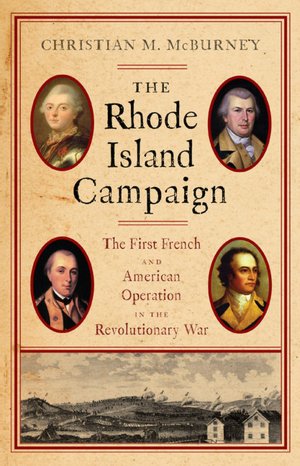
Christian McBurney, The Rhode Island Campaign: The First French and American Operation in the Revolutionary War Yardley, PA: Westholme Publishing, 2011.

Thursday, March 15
6:30 p.m.
The John Brown House Museum
52 Power Street Providence, RI

Tonight Christian McBurney gave a lecture at the illustrious John Brown House Museum on the subject of what is commonly called "The Battle of Rhode Island." In December 1776, the British invaded Narragansett Bay and occupied the city of Newport, and stayed until 1779. McBurney has written what is likely to be regarded as the definitive modern interpretation of the events of that occupation and the joint efforts of the French and the American patriots to liberate Newport.

Though not as well attended as McBurney's lecture several years ago that accompanied his book on Kingston (A History of Kingston, R.I.,1700-1900, The Heart of Rural South County, 2004), it should have been better attended. This lecture was more informative and authoritative and far less "antiquarian" than his lecture (and most recent tome -- McBurney has written two) on Kingston. If only I had the money to plunk down for a copy of his new book tonight, but alas! all my cash had gone to renewing my RIHS membership, which was lapsed and which I had been meaning to renew for some time now. I will try to get to his upcoming lecture next month in Bristol on the British attack there and get a copy of it then.

After the lecture, I spent a few minutes talking to Mr. McBurney about the Tories who fled from the Narragansett Country to Newport during the British occupation. South Kingstown town records are mute on this subject, and the town's committee of safety left no records at all of their activities, let alone who might have been "invited" to leave or who left on their own volition. The most specific information I have come across in my research on the subject was in a letter from General Nathaniel Greene to Rhode Island governor Nicholas Cooke. Greene mentioned that perhaps as many as thirty planters had fled from the Narragansett Country to Newport with their slaves. My theory is that a combination of push-pull factors sent the local Tories hauling off to Newport--some were pulled by their loyalty to the Crown and disdain for the new order of things, while others were likely routed out by the local committee of safety. While there is no specific evidence to support this, I suspect the so-called "land pirates" who had accompanied the British on their 1779 Spring raids on South Kingstown, men like John Gorton, were exacting a bit of revenge on the community upon their brief sojourns into town and, if they could lead the British to them, even on the very revolutionaries that had forced them into exile.

During our brief discusion Mr. McBurney indicated that there is information about this heretofore uninvestigated group of Rhode Islanders. He suggested that more Tories fled from North Kingstown and even Exeter rather than from South Kingstown, and that this -- Rhode Islanders who joined the British cause in the Revolutionary War -- will be the focus of his next book. I am very much looking forward to such a study. If the same level of scholarship goes into a study of Rhode Island Tories as The Rhode Island Campaign, Christian McBurney's next book will be very welcome indeed.

Sunday, February 19, 2012

Neil Dunay, "Documenting Slavery at Cocumscussoc"

Saturday, February 18, 2012
2:00 p.m.
North Kingston Free Library
100 Boone Street, North Kingston, RI

"From the late 17th century to the early 19th century, Cocumscussoc (Smith’s Castle) was a large plantation spanning thousands of acres that depended upon slave labor to produce and ship goods and to serve the household. Biographical material about the enslaved people at these sites is scant. Neil Dunay, a past president of Smith’s Castle, will provide a preliminary overview of the information about slaves at Cocumscussoc gleaned from historical records.

This presentation forms the basis for a grant proposal to find additional information to provide a more informed picture of the lives of enslaved and indentured laborers at Cocumscussoc, as well as of the Smith/Updike family's roles in the institution of slavery."

I found out about Neil Dunay's presentation after I had stopped by Smith's Castle on a whim a couple of Saturday's ago. I had been sent to pick up some tax paperwork in North Kingstown for the Prius we bought last year and I was heading down Route 1 South to the URI library in South Kingstown to pick up some books. As I came up on Smith's Castle I suddenly decided to take a minute and pull in. I am in the early stages of researching a journal article about Connecticut and Rhode Island's "war of officials," part of their struggle from 1663 into the early 1700s over the jurisdiction of Narragansett Country -- better known to most Rhode Islanders today as South County. I have some questions about the destruction of the trading post in the spring of 1677, and if anyone could answer them, it would be the folks at the trading post itself.

There usually isn't anyone at Smith's Castle this time of the year, but I was fortunate -- Norma LaSalle and Neil Dunay were both there, doing a little late winter cleanup and supervising some folks doing community service. Neil and I sat down for a bit and talked about the region in the 17th century and the contest over jurisdiction between the two colonies. Neil and Norma were also kind enough to also front to me on credit a copy of the Association's recent publication, Smith's Castle at Cocumscussoc: Four Centuries of Rhode Island History, which is absolutely filled with the sort of details that will liven up my eventual journal article.

Before I left I also grabbed a couple of flyers for Neil's upcoming talk "Documenting Slavery at Cocumscussoc," and I promised Neil I would be in attendance. The flyers themselves were striking -- the background is an excerpt from Earnest Hamlin Baker's mural Activities of the Narragansett Planters, which from the Depression was on display in the Wakefield Post Office and is now housed at the Pettaquamscutt Historical.

Dunay's research has teased the scant details of the lives of the slaves that lived at Cocumscussoc largely from documents ostensibly created for and by the plantation's white owners and occupants. He also makes key geographic connections between colonial Wickford, New York City and the Barbados. While some of the principle characters in the story had interactions with slaves going back into the 1630s (including Gysbert Opdyck's murder of his black servant in 1639), the history of slavery at Smith's Castle began in earnest in the aftermath of King Phillip's War, when captured Narragansetts and other Native Americans were "exported" from the trading post and sold into slavery in the West Indies. Upon Richard Smith Jr. death in 1692, his probate listed eight black servants as part of his estate. At this point the plantation passed to the Updike family, relatives of Richard Smith Sr. who had been living at Cocumscussoc from about 1664. Through family connections in Barbados the Updikes came to acquire a number of slaves; by 1757 the plantation's slave population had increased to eighteen. Compared with southern plantations, eighteen is not large number of slaves, but for Rhode Island's Narragansett Planters it placed them among the largest slaveholders in the region.

The institution of slavery at Smith's Castle began to decline from this high point in 1757. Like most of the large landholdings of the Narragansett planters, with each successive generation the plantations were divided into smaller and smaller farms, as Rhode Island lacked a western frontier that had enabled Southern planters to simply send most of their excess progeny to farm their frontier lands. Eventually by the 1770s the division of lands in the Narragansett Country reached the point where most planters could no longer support the kind of large-scale commercial agriculture that required the labor of numerous slaves. By the census of 1774 the number of slaves at Smith's Castle fell to eleven. During the Revolutionary War some of the plantation's slaves took advantage of Rhode Island's manumission for enlistment in the 1st Rhode Island Regiment in 1778. In the years following the war, the General Assembly passed a system of gradual emancipation, and by 1800 only two slaves remained. State law forced the owners of slaves too old or infirm to support themselves to be maintained in their households of their masters, rather than see them go onto the town's poor rolls.

Perhaps the best aspect of this presentation was its digital format -- the visuals and text of the presentation were on a Prezi slide show, which can be accessed on the Prezi site (Documenting Slavery at Cocumscussoc). For anyone not familiar with Prezi, presentations in this format allows one to shift from images of primary source documents, maps, and art that in a way far superior to a PowerPoint presentation. Images and text can be "buried" inside other images; the effect is like a visual counterpart to the old-fashioned text outline. While the slide show is missing Neil Dunay's expert narrative to tie it all together, much of the experience of attending the presentation yesterday is preserved there for all posterity, which to me is another reason to be excited about the digital revolution taking place in the documenting of history today!

Dunay, Neil. “Documenting Slavery at Cocumscussoc.” http://prezi.com. http://prezi.com/g40moi3ymfgl/documenting-slavery-at-cocumscussoc/ (accessed February 18, 2012).

Sunday, July 24, 2011

Catawampus indeed

While perusing their online thesaurus, I discovered on Dictionary.com this list of 27 words once on the cutting edge of American slang, that in some cases have been (thankfully) long-since retired.

I find lists of these old words irresistible, but then again, I enjoy reading the dictionary... Some of the words listed arguably are more exiguous than anachronous, but that's a donnybrook for another day.

The First English Dictionary of Slang 1699 was recently reprinted by the folks at the Bodleian Library at Oxford University after they recently discovered they had still a copy of the over three hundred year-old book.

"Originally entitled A New Dictionary of Terms, Ancient and Modern, of the Canting Crew, its aim was to educate the polite London classes in ‘canting’ – the language of thieves and ruffians – should they be unlucky enough to wander into the ‘wrong’ parts of town.

With over 4,000 entries, the dictionary contains many words which are now part of everyday parlance, such as ‘Chitchat’ and ‘Eyesore’ as well as a great many which have become obsolete, such as the delightful ‘Dandyprat’ and ‘Fizzle’.Remarkably, this landmark of English from 1699 was compiled and published anonymously, by an author who has left us only his initials – ‘B.E. Gent [gentleman]’.

Playfully highlighting similarities and contrasts between words, B.E. includes entries ranging from rogues’ cant, through terms used by sailors, labourers, and those in domestic culture, to words and phrases used by the upper classes..."


Sample Entries
  • Anglers, c. Cheats, petty Thieves, who have a Stick with a hook at the end, with which they pluck things out of Windows, Grates, &c. also those that draw in People to be cheated.

  • Arsworm, a little diminutive Fellow.

  • Buffenapper, c. a Dog-stealer, that Trades in Setters, Hounds, Spaniels, Lap, and all sorts of Dogs, Selling them at a round Rate, and himself or Partner Stealing them away the first opportunity.

  • Bumfodder, what serves to wipe the Tail.

  • Bundletail, a short Fat or squat Lass.

  • Cackling-farts, c. Eggs.

  • Dandyprat, a little puny Fellow.

  • Farting-crackers, c. Breeches.

  • Fizzle, a little or low-sounding Fart.

  • Humptey-dumptey, Ale boild with Brandy.

  • Grumbletonians, Malecontents, out of Humour with the Government, for want of a Place, or having lost one.

  • Keeping Cully, one that Maintains a Mistress, and parts with his Money very generously to her.

  • Knock down, very strong Ale or Beer.

  • Lantern-jaw’d, a very lean, thin faced Fellow.

  • Mawdlin, weepingly Drunk.

  • Mopsie, a Dowdy, or Homely Woman

  • Muddled, half Drunk.

  • Mutton-in-long-coats, Women. A Leg of Mutton in a Silk-Stocking, a Woman’s Leg.

  • One of my Cosens, a Wench

  • Pharoah, very strong Mault-Drink.

  • Princock, a pert, forward Fellow

  • Provender, c. he from whom any Money is taken on the Highway.

  • Strum, c. a Periwig. Rum-Strum, c. a long Wig; also a handsom Wench, or Strumpet.

  • Urchin, a little sorry Fellow; also a Hedgehog.

  • Willing-Tit, a little Horse that Travels chearfully.

  • Alack, alas! A real wizard manifest!

    Wizards, The One Wiki to Rule Them All (fair use)

    No! not THAT sort of wizard...

    Wednesday, July 20, 2011

    A Rumely Oil Pull at a Middle-Aged Fair

    A 1926 Rumely Oil Pull, Model L, recently seen on the last day of Connecticut's North Stonington Fair in 2011.


    These machines are fairly rare today -- so many old tractors were sold for scrap to build Liberty Ships in the Second World War. Of the 4,855 Model L tractors built between 1924 and 1927, only 149 are known to exist today (about 3%). The story of the Rumely, like some of the other early internal-combustion engine tractors, has a storied past that dates back to before the Civil War.

    That story began in 1853 when German immigrant Meinrad Rumely opened a blacksmith shop in LaPorte, Indiana. The M. & J. Rumely Company went through several phases, mergers and buyouts all the while manufacturing agricultural equipment such as threshers and separators. In 1872 Rumely built its first steam engine, and in 1886 it rolled out its first steam tractor, which burned straw as fuel. Over the next decade Rumely expanded its line of steam traction machines, and in 1909 it tested its first kerosene-powered tractor, the "Kerosene Annie" under the direction of Meinrad's grandson, Edward A. Rumely, who wrote that year:

    MAN made his first step toward civilization when he took a crooked stick and began to till the soil, using first the force of his own muscles. Later he learned to apply the power of the animal to the work. Upon cultivating the soil, he became master of the plants and shaped them to serve his purposes. With the plow the savage life of the hunter and the nomad life of the herder gave way to that settled agriculture that now yields our food supply and upon which rests our modern civilization.

    Strangely enough, this work of plowing with which man began his systematic labor remains today still his severest toil. For man, as well as animals on the farm, the dusty and monotonous work of plowing is the hardest drudgery. Think of the power required to pull a plow only the distance across the room, and then of the eight miles of furrow travel in every acre of land. To plow a square mile one man and two or three horses must walk 5,200 miles each. It is easier and the distance less to walk around the earth at the equator than to follow a plow turning a tract of five square miles. To plow three townships the plowman must walk as far as from the earth to the moon and back again and sixty thousand miles farther. Ten horse power hours are needed to turn an acre of land, and to plow one half the area of the United States nine billion four hundred and fifty-four million seven hundred and thirty-six thousand (9,454,736,000) horse power hours are required...

    --Edward A. Rumely, Toiling and tilling the soil, a 1909 Rumely oil-pull tractor sales brochure

    The early steam and kerosene tractors (circa 1870-1920) were very large machines. Only the wealthiest farmers could afford them, and often a single steam tractor would be used to do work on a number of farms in its vicinity. But in the 1920s Rumely (and a number of other tractor manufacturers, such as Ford) redesigned some of its machines and made them smaller and lighter, like the Model L pictured here. These tractors were designed and priced to replace the single team of horses found on a small farm. The University of Nebraska Tractor Test reported that in the Model L drawbar horsepower test the Model L generated around 18 to 19 HP.

    These Model L Oil Pulls were some of the last tractors made by Rumely. Better designs from their competitors and the Great Depression unfortunately conspired against the Advance-Rumely Company, as the company was known by then, and it was bought out by Allis-Chalmers in 1931. [Thanks to David Parfitt and Chris and Rod Epping for a refresher on Rumely's history]

    Any of these old tractors are a favorite at steam and antique tractor shows. We were fortunate enough to see this one running later in the day, though we missed it being started up, which is always an adventure to watch. One of the fascinating things about all these old machines is the low RPM of the engine, which idle at less than 200 rpm.

    Few people today would even know how to start one of these tractors--the "key" would certainly never fit in your pocket, though it would have been near impossible to misplace!
    Starting a Rumely

    Some start these tractors by simply grabbing or the flywheel or pushing on it with their feet and giving it a good spin. Don't try this at home folks.
    Starting a Rumely II

    No power-steering on these either.
    Larger "Prairie" machines

    Ever wonder why the flywheels were left exposed? Before the days of the PTO (power take-off), the pulleys powered belt-driven threshers, saw mills, and other machinery.
    Threshing Demonstration


    The North Stonington Fair, always held in the second week of July, is a particular favorite because it is the first major fair of the season -- the next major Connecticut fair will not be until the end of August. The North Stonington Fair holds its antique tractor pull on Sunday starting around noon (the pull for newer models and modified tractors is on Thursday, the first night of the fair). Though the Rumely didn't compete (metal-wheeled tractors aren't allowed), there were a number of pre-1955 John Deeres, Olivers, Farmalls, Allis-Chalmers, Fords and even a Canadian Cockshutt (see below) pulling several times their weight in cement blocks. In the end, a pull of only a few inches decided the winner.


    The fair itself is not among the older fairs in Connecticut; the 2011 fair was the 47th edition, putting this particular fair squarely in so-called middle age.

    Because 47 is not old.