So once again we've just about frittered away yet another perfectly good summer.

-- "What about existential dread? Can that be a hobby?"


 Posts
All Comments
Posts
All Comments
I finally made the trek to Wakefield Books in my car -- I have been in in Wakefield several times recently on the Grom, but without saddlebags it's a bit dicey carrying much in the netting on the passenger section of the seat.
And its been too hot to ride around with a backpack on.
Skip to the end -- I walked up to the History section and there in the middle of the display...

I had just finished re-reading all of The Expanse novels when I heard that Chris McBurney's most recent book was a study of the destructive effects of Rhode Island privateers upon Britain's slave trade during the Revolutionary War. I decided to check it out, as it might inform parts of the Rhode Island History course I am proposing. So far I am four chapters in, and there definitely are details that will broaden the depth of those parts of the course examining the American Revolution, slavery, and BIPOC populations.
 |
| Fresh out of the bag |
Once I have finished reading Dark Voyage, I will review it on Amazon and also post my thoughts here on the blog.
This is the promo for Dark Voyage in Christian's latest email:
My new book is called Dark Voyage: An American Privateer's War Against Britain's African Slave Trade. The privateer was constructed from and departed Providence in 1778, during the American Revolutionary War. Its officers and crew hailed mostly from North Kingstown, Exeter and South Kingstown. This privateer sailed to West Africa and inflicted more damage against Britain's slave trading forts and ships than any privateer during the war. It is a remarkable story, never before told.
We should all support Rhode Island’s wonderful independent bookstores and historical society gift shops! Currently, their price for Dark Voyage is no higher than amazon.com’s ($35). These outlets have Dark Voyage in stock:
- Wakefield Books, Wakefield Mall (many copies in stock and best price)
- Charter Books, Newport, 8 Broadway (just north of the Old State House; it is a wonderful, bright, new bookstore) (book signing on August 9, at 6 pm!)
- Commonwealth Books, Newport, 29 Touro Street
- Barrington Books, Barrington, 184 County Road
- Newport Historical Society Gift Shop, Newport, 127 Thames Street (Brick Market building)
- Island Books, Middletown, Wyatt Square, 575 E. Main Road
- Books on the Square, Providence, 471 Angell Street
- Stillwater Books, Pawtucket, 175 Main Street
- Island Bound Bookstore, Block Island, Water Street
- Block Island Historical Society Museum Shop, 18 Old Town Road
- Rhode Island Publications Society at https://ripublications.org/rips-store/
(Most of the above stores also carry my books The Rhode Island Campaign: The First French and American Operation in the Revolutionary War and Spies in Revolutionary Rhode Island.)
To purchase the book online at amazon.com, click here.
You can also purchase from the publisher’s website.
If you do purchase Dark Voyage, it would be greatly appreciated if you could complete a review of it on amazon.com. Such reviews are particularly helpful to authors who do not have big New York or London publishers behind them.
Thank you for being a reader and supporter of smallstatebighistory.com.
Be safe this weekend!
Christian McBurney
Editor and Publisher, The Online Review of Rhode Island History
___________________________________________________
Remember -- and NEVER FORGET

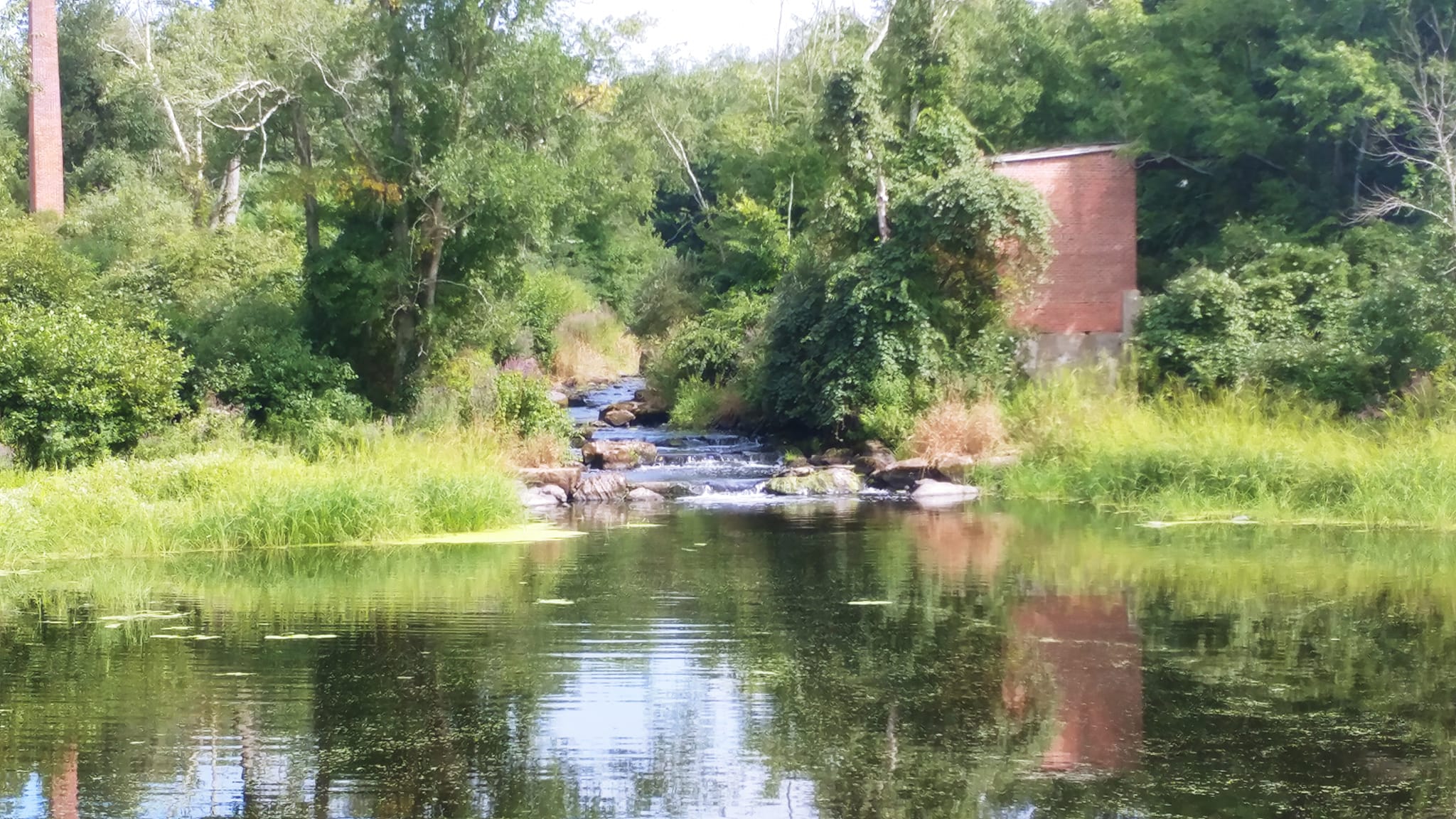
Wednesday I was driving to the opening day of the Washington County Fair in Richmond, coming from Wakefield Books and Hera Gallery in South Kingstown. Rather than battle the congestion of summer traffic on Route One, I took Worden's Pond Road and wended my way through the mill village of Shannock.
I stopped for a few minutes to take photos of this monument.


.png) |
| Map of the Shannock Historic District, RIHPHC 1983. The location of the monument is the red dot, beside the bridge on Shannock Road over the Pawcatuck River. The falls are labeled 52, and the ruins of the power building are labeled 53. |
"The Narragansetts and Pequots were rivals and they repeatedly fought for local dominance in Niantic territory. Their most famous battle occurred at Shannock Falls. Here, the Narragansetts successfully defended the important fishing rights which they controlled" (Charlestown, 6)
A similar snippet is found in the 1937 report of the Rhode Island Tercentenary Commission for a site the Commission called "Shannock Hill" (which is actually located a mile or so north of the falls and the site of the battle; see map below). The Tercentenary Commission were responsible for erecting the monument, in celebration of the 300th anniversary of Rhode Island's founding.
"Here the Narragansetts won a fierce battle against the Pequots for control of the fishing falls. A wooden marker was placed by Rhode Island Historical Society June 1897 on the 250th Anniversary of the Death of Canonicus."
 |
| Topographic map of Shannock Hill (elevation 269 feet at red marker), in relation to the Shannock Village Historic District and Shannock Falls (inside rectangle) at the foot of the hill. |
The latter account does provide more information about the history of the monument, but nothing more about the battle itself. It's possible there are narratives nearer to the time of the actual battle -- Roger Williams did spend quality time with his friend, Narragansett leader Canonicus, in the 1630s and 1640s before the sachem's death in 1647. Williams may have recorded something Canonicus told him about this event, but I have yet to find anything attributed to him about it. (Yeah, me -- yet another good argument for picking up the seven-volume set of The Complete Writings of Roger Williams...scanning it, OCR'ing it and making all 3,052 pages keyword searchable.) If the battle took place after 1580, Canonicus likely fought in it and if he did not, he would have been able to provide a narrative of the conflict considerably longer than two sentences I've been able to find.
But just as likely there is no greater account of the Battle of Shannock Falls in Roger William's surviving papers, because there is exactly zero mention of it in Elisha R. Potter Jr.'s 1835 account, The Early History of Narragansett. Like most antiquarian historians, Potter's narrative relies on -- in his words -- "printed or manuscript works of writers living at the same time with, or soon after the events they describe; the records of the state and towns; and tradition." While he offers little information beyond simply re-writing what he read, with little to no interpretation of events, had he encountered the details of the Battle of Shannock Falls he doubtlessly would have included them.
This is what Elisha R. Potter Jr. wrote about the Pequots, Narragansetts, and their boundary disputes:
Roger Williams says the Indians were very particular in the boundaries between different tribes: " The natives are very exact and punctual in the bounds of their lands, belonging to this or that Prince or People, (even to a River. Brooke.) &c... (Potter, footnote on xi)
The Narragansett Tribe, occupied the whole of the present county of Washington, excepting the country between Pawcatuck river and Wekapaug [sic], the possession of which appears to have been a frequent subject of contention between them and their western neighbors the Pequots. The Narragansetts, however, appear to have taken final and quiet possession of this disputed tract, alter the destruction of the Pequots, in 1637... (Potter 1)
...[John] Winthrop mentions that there was a quarrel between [the two tribes] this year, (1634,) and that the Pequots endeavored to obtain the assistance of the English, "because they were at war with the Narragansetts..." (Potter 17)
The Pequots had, according to some accounts, pushed their conquests into the Narragansett country, as far East as Wecapaug Brook; and these two tribes were always at variance (Potter 23)
While it is possible the Battle of Shannock Falls took place in 1634 as part of this conflict between the two tribes, Potter's account includes no actual details about the Pequot's quarrel was with the Narragansetts or where any actual fighting took place. The only location Potter references is Weekapaug, Niantic territory along the coast in present-day Westerly, a good 15 miles to the south and east of Shannock. It is a better argument based on the evidence that the conflict in 1634 was over which tribe maintained hegemony over the Western Niantics along the coast rather than inland fishing rights on the Pawcatuck River in Charlestown and Richmond. It is not possible to connect anything Potter reports to the battle in Shannock.
Based on the evidence at hand, the story of the battle began as Narragansett oral tradition that was passed on to the English at some point after the "Vacant Lands" were sorted out, and after the location for the Narragansett reservation was established in 1709, in what later became the town of Charlestown in 1738. That it is based on a tradition passed on by white settlers explain why there are no other details that accompany the story.
I have a theory (absolutely unprovable), about the origins of the story, since it doesn't appear in early written accounts. Early white settlers in Charlestown would have purchased lumber from the so-called Indian Saw Mill, which operated from c. 1700 to 1900 on Old Mill Road. The saw mill is in the heartland of the region that the colony of Rhode Island reserved for the Narragansett. The ruins of the saw mill are only about a mile and half miles south of Shannock Falls, not far from Narragansett Trail.
 |
| The remains of the Indian Saw Mill, located on Saw Mill Pond off of Old Mill Road, Charlestown RI |
The Indigenous operators of the saw mill told the story of the battle to their white customers in the early 1700s. The story about the battle at the falls continued to be passed down by word of mouth among white Rhode Islanders, until the first marker was finally erected in the late 1800s. There is evidence of similar local "folk traditions" passed on among Charlestown's white inhabitants. The saw mill was certainly a point of contact between Charlestown's white and Indigenous societies, and perhaps it took on a similar role to that of the local barbershop, passing on tales of local events between its operators and customers.
If I do discover any more evidence beyond "there was a battle here," I will update this post.
______________________________________________
Christensen, Robert O., Shannock Village Historical District. National Register of Historic Places Inventory - Nomination Form, June 1983. https://preservation.ri.gov/sites/g/files/xkgbur406/files/pdfs_zips_downloads/national_pdfs/charlestown/char_shannock-village-hd.pdf
Davis, Jack L., "Roger Williams among the Narragansett Indians," The New England Quarterly, Vol. 43, No. 4 (Dec., 1970), pp. 593-604. https://www.jstor.org/stable/363134
Nebiker, Walter, Historic and Architectural Resources of Charlestown, Rhode Island: A Preliminary Report. Rhode Island Historic Preservation and Heritage Commission, June 1981. https://preservation.ri.gov/sites/g/files/xkgbur406/files/pdfs_zips_downloads/survey_pdfs/charlestown.pdf
Potter, Elisha R. The Early History of Narragansett: With an Appendix of Original Documents, Many of which are Now for the First Time Published. Providence, Marshall, Brown and Company, 1835. https://www.google.com/books/edition/The_Early_History_of_Narragansett/gjazs0_D9owC?hl=en
Rhode Island tercentenary, 1636-1936. A report by the Rhode Island Tercentenary commission of the celebration of the three-hundredth anniversary of the settlement of the state of Rhode Island and Providence Plantations, Rhode Island Tercentenary Commission. Providence, 1937. https://babel.hathitrust.org/cgi/pt?id=hvd.hxta8y&view=1up&seq=165&skin=2021&q1=Shannock
All photos and images by the author unless otherwise noted.
Yesterday I was reading a recent article in an online journal I follow closely. The article, entitled "Benjamin Church, The First American Ranger" recounts the exploits of none other than Benjamin Church, that soldier for Plymouth Colony who took part in the Great Swamp Massacre and who is credited with incorporating Native American stealth tactics into fighting in the various wars of that age, down through to today.
One of those forgotten men is a Rhode Islander who played a pivotal role in saving the English New Englanders from losing the war to the Indian leader, Metacom, or as the English knew him, King Philip, and his allied warriors. The Rhode Islander did so by learning and implementing the superior war tactics of the Indians during the summer of 1676. Along with his contribution to the English victory he also set in motion a new style of war that would be used for hundreds of years in North America. These tactics helped America claim its independence from Great Britain and an evolved version of these tactics are still used to this day by one of America’s most elite military units, the United States Army Rangers. This largely forgotten man is Benjamin Church and he was the “The First American Ranger.”
Benjamin Church's other great claim to fame was identifying the body of Metacom (King Phillip) after he was assassinated by Wampanoag "praying Indian" John Alderman. Church, by his own account, ordered Metacom's body to be drawn and quartered. Phillip's head was taken to Plymouth and left on a spike that overlooked the town for decades after.
Drawing, quartering, and spiking heads is all a bit medieval, but that was New England society in the seventeenth century. A bit medieval.
But the article never mentions that, or looks critically at the primary source that much of this narrative draws upon. I am not a fan of writing that celebrates as heroes violent men responsible for slaughtering Indigenous peoples. Or writing that takes a biased primary source at face value without providing necessary context or any critical examination. It is an interpretation more typical of histories written in the 1920s than in the 2020s.
And I take offense to another inaccuracy made repeatedly in this narrative: that Church was a Rhode Islander.
As a Rhode Islander, I will refute that claim this morning then head off to celebrate my birthday at the Newport Jazz Festival.
According to the genealogical website "Church [Family] History in America" Benjamin Church's father, Richard, arrived at Plymouth colony in 1630 with the same fleet that carried John Winthrop. Richard Church was a carpenter and he built the settlement's first Puritan meeting house of worship. Benjamin too was a carpenter, when he wasn't hunting down Indians, but more importantly he was a Puritan. Seventeenth-century Puritans despised Rhode Island and the heretics who dwelt there. In 1643 Plymouth, Massachusetts and the settlements that eventually became Connecticut formed the New England Confederation, to unite the militaries of the Puritan and Separatist colonies -- and deliberately left Rhode Island out of the alliance while making numerous claims against her territory. Massachusetts even invaded Rhode Island that same year to arrest Warwick's founder Samuel Gorton and drag him back to Boston. Nor was it the last time Massachusetts would.
I suspect Benjamin Church, an early second-generation Puritan, would be loathe to be referred to today as a Rhode Islander -- a rabble rife with Baptists, Gortonites, Antinomians, and Quakers.
Truth is, Benjamin Church never lived in Rhode Island.
Fact check. Wikipedia claims that Church died on "January 17, 1718 (aged 78–79) [in] Little Compton, Rhode Island." However, Little Compton was originally part of the homelands of the Sakonnet people before the arrival of the Pilgrims in 1620, and remained so into the 1670s. Church built a house there in 1674 just a year prior to the outbreak of King Phillip's War. In 1682, after the English victory over the Indians of southern New England, Sakonnet was renamed Little Compton and officially incorporated into the Plymouth colony (see map below).
 |
| Little Compton and Plymouth Colony, c. 1690. The area in the 2022 Google Map (below) is in the rectangle (above) Image credit: Tenterden and District Museum |
Then in 1685 Plymouth, New Hampshire, Rhode Island, Massachusetts, Connecticut, New Haven, New York and East and West Jersey were reorganized into the Dominion of New England by King James II, until the Glorious Revolution of 1688-89. In the aftermath, Plymouth, which had operated for over 70 years without a charter from England, was officially made part of Massachusetts Bay. Benjamin Church would have learned of this in the spring of 1692, when newly minted royal governor Sir William Phips arrived in Boston after William and Mary refused to grant him for a charter for Plymouth.
So Church's house started off in Sakonnet Indian territory, which after King Philip's War became Little Compton, a town in Plymouth, then Plymouth became Massachusetts. Then Church died and was buried in the Old Commons Burial Ground -- known today as Rhode Island Historical Cemetery Little Compton #12.
.jpg)
Little Compton remained a Massachusetts town until a boundary dispute with RI was resolved in Rhode Island's favor in 1747 (see the Mass/RI boundary above). However, Benjamin Church died 29 years earlier, when everywhere on this Google map was Massachusetts, not Rhode Island. It maybe a bit much to expect Wikipedia editors to notice this discrepancy, though someone should go in and fix that. If I cared enough about Benjamin Church having an accurate biography on Wikipedia I would probably do it myself.
So what about the argument that Benjamin Church was a Rhode Islander? Here is another section of the article that makes this claim:
Church was born in Plymouth Colony (now part of Massachusetts) in 1639 and learned to hunt and trap at a very early age. After marrying in 1667, Church eventually became one of the first settlers of “Sogkonate” (anglicized to Sakonnet) land that is now part of Little Compton, Rhode Island. Soon after his arrival in Rhode Island in 1674, he encountered the Sakonnet tribe...
This passage argues that Church arrived in "Sogkonate" in 1674, and that this was "in Rhode Island." It was not. It wasn't even part of Plymouth yet. In fact it wasn't even Little Compton yet, and it would not be part of Rhode Island until Benjamin Church had been dead and buried in the Massachusetts ground for nearly three decades.
Or more accurately, entombed just above the ground. if one were to visit the Old Commons Burial Ground (see Google Map above), Benjamin Church's place in the social structure of early Little Compton becomes clear. He and his entire family, including small children, are laid to rest in expensive altar tombs -- unlike the cemetery's other residents who are buried in the ground behind more modest headstones.

 |
| Top, Benjamin Church's altar tomb (center), Old Commons Burial Ground (see map below). All these altar tombs in both photos are member's of Church's family. image credit: Caitlin GD Hopkins |
Now let us look at the problems that arise from taking a biased primary source at face value without providing necessary context. For that, let's turn to the research of Jillian Lepore (Harvard University's David Woods Kemper '41 Professor of American History), then the work of Guy Chet (Professor Of History at the University of North Texas).
Jillian Lepore explored the conflict in her 1998 Bancroft prize-winning book, The Name of War: King Philip's War and the Origins of American Identity. For those who have not yet read Lepore's book, there are several well-produced videos online of her speaking about it, including this one she gave to the Gilder Lehrman Institute in December 2010. To summarize her lecture (and book), Lepore
…traces the meanings attached to [King Phillip's War]. Lepore examines early colonial accounts that depict King Philip's men as savages and interpret the war as a punishment from God, discusses how the narrative of the war is retold a century later to rouse anti-British sentiment during the Revolution and finally describes how the story of King Philip is transformed yet again in the early nineteenth century to portray him as a proud ancestor and American patriot. Through these examples, Lepore argues that "wars are just as much a contest for meaning as they are for territory, and wars are indeed just as much a contest for memory as they are for political allegiances."
 |
| Jillian Lepore during a presentation on The Name of War, at the Gilder Lehrman Institute of American History, December 1, 2010. |
The Name of War is a deeply researched and highly regarded interpretation of King Phillip's War... which the article in question never cites or references.
Lepore also provides a historically-grounded critique of Church's "The entertaining history of King Philip’s War" -- which she reads as not as a biography not by Church but a hagiography written by his son Thomas -- in her 2006 piece for The New Yorker, "Plymouth Rocked:"
"This as-told-to, after-the-fact memoir is the single most unreliable account of one of the most well-documented wars of the Colonial period. More than four hundred letters written by eyewitnesses in 1675 and 1676 survive in New England archives, along with more than twenty printed accounts, written as the war was happening, or very shortly thereafter. But even though “Entertaining Passages” was compiled forty years after King Philip’s War had ended and may well have been entirely written by Church’s son (who, at the very least, edited his father’s “notes” considerably)...[some historians have used] it without reservation or caution.
Similarly, Guy Chet's 2007 article in the Historical Journal of Massachusetts "The Literary and Military Career of Benjamin Church: Change and Continuity in Early American Warfare," questions two arguments this article makes: first, that Church is the progenitor of the US Army Ranger corps, and second, that he was instrumental to the English victory over the Wampanoag and their allies.
For a war that began in June 1675 and killed at least 10% of the region's inhabitants, Benjamin Church
"had an undistinguished career until the summer of 1676, when he...started to accumulate tactical victories over Indian forces. At that point the remaining mutinous tribes were already starving, weakened, politically isolated, and on the run from English and Indian forces (Chet 107).
Despite Church's heroic narrative that places him at numerous critical turning points of the conflict forty years after the fact, contemporary accounts written during the war hardly mention him. The most extensive account of his activities during the war were written by Boston minister Increase Mather, whose Brief History of the Warr With the Indians in New England (published in 1676) only mentions Church "in a July 1676 entry -- the closing stages of the war -- in which Mather states that Church recruited Indians to hunt other Indians" and "nothing...about Church being the conqueror of Philip." The other occasion Benjamin Church comes up in Mather's account was in a discussion of 1677 after the war was over, and in the book's Postscript. Other accounts written in 1675-1676 do not mention Church at all. (ibid 109).
As to how Church gained his reputation as an influential tactician and the father of the American small-unit tactical warfare, Chet finds it "striking about this wide-ranging credit is that Church seems to have won it posthumously" and that "Church's exploits, his story and legacy were products of the Jacksonian era more than the colonial period (ibid 108).
His memoirs, Entertaining Passages relating to Philip’s War, written in part or in full by his son Thomas, offer a narrative that, understandably, highlights Church's successes and places him at the center of the story of the war. However, Entertaining Passages was published forty years after King Philip's War (1716), so nobody could have read and learned from Church for at least four decades, unless it was by word of mouth. The second edition of Church's memoirs was published in 1772, almost a hundred years after the war. A third edition appeared in 1825...a fourth edition in 1827; a fifth in 1829; a sixth in 1834; a seventh in 1842 an eighth (in two volumes) in 1865 and 1867. A ninth edition appeared in 1975...and a digital version...in 1999 (ibid).
Chet's interest in Benjamin Church as well as another frontier fighter, Robert Rogers, as the genii of modern American warfare, are primary to the investigation of his 2003 book, Conquering the American Wilderness: The Triumph of European Warfare in the Colonial Northeast, the title of which is a bit of a spoiler here. A number of military histories regale both men as instrumental in the use of stealth, surprise, and deception that developed the uniquely American small-unit tactics that won the Revolutionary War for the United States. Chet sought to locate "the instructional mechanism by which the knowledge acquired by Church [and Rogers] was disseminated among colonial officers from one generation to the next." But he couldn't find it, because it did not exist.
What Chet discovered instead was that the stories about Church and Rogers being the fathers of the Ranger corps were ahistorical narratives centered in American exceptionalism and Turnerian glorification of the frontier long after the colonial era, rather than how the colonists and (later) the Americans actually fought in the seventeenth and eighteenth centuries. In reality, what Chet uncovered was that most colonists (and the their militias) were far more aligned with the Atlantic world and British battle tactics than with the individualism and stealth of a hunter or Indian fighter on the colonial frontier (ibid 106).
So no, whatever the US Army's Ranger Handbook and the article "Benjamin Church, The First American Ranger" say to the contrary, Benjamin Church was NOT the father of the "American" stealth military tactics, nor did he play "a pivotal role in saving the English New Englanders from losing" King Philip's War.
Nor was he a Rhode Islander.
The reality was that actual Rhode Islander's -- both English and Indigenous -- intended to stay out of this brutal conflict. Rhode Island was INVADED by the United Colonies of Connecticut, Plymouth and Massachusetts Bay and their Pequot and Mohegan allies in December 1675. Their intention was to massacre the Narragansetts in their winter fort in what is today South Kingstown, just like Massachusetts Bay colonists and their Indian allies had done to the Pequot fifty years earlier. And not only Narragansett warriors but their elders, women and children. Men like Benjamin Church who, coming upon Metacom's assassination, according to his own "entertaining" story, called Phillip "a doleful, great, naked, dirty beast" as he lay bleeding to death on the ground (and if those are not words Thomas Church put in his father's mouth forty years after the fact).
Nonetheless, I would argue that passage says more about how Church really felt about Indigenous people than the kumbaya story that "Benjamin Church, The First American Ranger" relates about Church breaking bread with Wampanoag sachem Anawan after capturing him in the summer of 1676. Another story from the Entertaining Passages Relating to Philip’s War that, like nearly that entire source, is not corroborated anywhere else.
While Church is remembered rightfully as one of the early founders of Little Compton, he was NEVER a Rhode Islander. Just because his grave happens to be in Rhode Island now, that isn't our fault.
_________________________________________________
Bornt, Daniel J. "The Church Family in America 1630-1935" in The Church Family of Petersburgh, NY featuring descendants of Frank and Myrtle Church, 2002. https://churchtree.tripod.com/churchhist.html
Chet, Guy, The Literary and Military Career of Benjamin Church: Change and Continuity in Early American Warfare. Historical Journal of Massachusetts, January 2007.
Hopkins, Caitlin, "Benjamin Church" Vast Public Indifference: History, grad school, and gravestones! May 30, 2009. http://www.vastpublicindifference.com/2009/05/benjamin-church.html
Lepore, Jillian, "Plymouth Rocked: Of Pilgrims, Puritans, and professors." The New Yorker, April 24, 2006. https://www.newyorker.com/magazine/2006/04/24/plymouth-rocked
- The Name of War: King Philip's War and the Origins of American Identity. Knopf Doubleday Publishing Group, 1999.
- "The Name of War: King Philip’s War and the Origins of American Identity" by Jill Lepore, History Resources, The Gilder Lehrman Institute of American History. Uploaded December 1, 2010. https://www.gilderlehrman.org/history-resources/videos/name-war-king-philip%E2%80%99s-war-and-origins-american-identity
Padula, Kevin, "Benjamin Church, The First American Ranger." The Online Review of Rhode Island History, July 30, 2022. http://smallstatebighistory.com/benjamin-church-the-first-american-ranger/
A fedora, according to the American Hat Makers website "Trilby vs Fedora - What's the Difference?" is "a high-crowned (typically 4.5 inches), broad-brimmed (two to three inches) hat with a teardrop shape and a pronounced pinch in the front." A trilby, while similar, is "a narrow-brimmed hat with a pinched, teardrop-shaped crown." The main difference between a trilby vs fedora is the brim size. Fedoras have a two to three-inch brim, while trilbies are often two inches or less.
Both style of hats originated in the late 1800s. According to the website "The History of the Fedora," the word fedora comes from the title of an 1882 play, Fédora, which
was written for Sarah Bernhardt. Bernhardt played Princess Fédora Romanov, the heroine of the play. During the play, Bernhardt – a noted cross-dresser – wore a center-creased, soft brimmed hat.
The play itself doesn’t have anything to do with hats, according to historian Phil Edwards.
"It’s a Russian tragedy about a woman who avenges her lover’s death (later, it was adapted into an opera of the same name). The thing that made Fédora stand out was Sarah Bernhardt’s performance."
But the hat was fashionable for women, and the women's rights movement adopted it as a symbol.
 |
| Sarah Bernhardt wearing a brimmed hat in a photo taken around the time she was in Fédora |
 |
| Image credit: americanhatmakers.com |
Meanwhile the trilby, according to the the American Hat Makers, comes from the title of the 1894 novel Trilby, whose main character's name was, oddly enough, Trilby.
"During a stage adaptation of the book, [Dorothea Baird, the actress who played Trilby in the British version of the play] wore a stingy brim sloped down in front, and up in back. The play was popular, and the name stuck. Since the play premiered in London, the trilby was first popular in English fashion before across the pond to the United States. It wasn't until the 1970s that the trilby started making the rounds in America. The film The Blues Brothers helped bring the style into the mainstream. More recently, Jason Mraz, Ne-yo, and Pharell Williams have been seen wearing trilby hats."
 |
| Dan Ackroyd and John Belushi wearing trilbys as Elwood and "Joliet" Jake Blues in the 1980 movie, "The Blues Brothers" |


 |
| Kim Philby's Trilby, on display in the International Spy Museum. Photo credit: spywrite.com |
 |
| Ron Carter (right) performs with Berklee faculty Steve Bailey (middle, electric bass) and Ron Savage (left, drums) (image by Dave Green) |
According to a Berklee news post a few days later,
"With 2,235 recordings to his name as a bassist (he set the world record in 2016 with 2,221), it’s no surprise that Ron Carter drops so many legendary names into his conversations that you need a shovel to scoop them up. During a recent guest lecture on campus, moderated by Steve Bailey, chair of the Bass Department, Carter would reference “Miles, Herbie, Wayne, and Tony” as if he was describing friends he met at a bar, and not his bandmates in Miles Davis’s Second Great Quintet. The group, which Carter was a part of from 1963 to1968, helped teach the bassist one of the most important lessons of his career: trust. “We understood that this music would have a life if we were responsible for it, if we trusted each [other’s choices],” he said."
"Carter went deep into his own process and technique, which vacillated between the technical (“What’s it going to take to make this D-flat on the downbeat of [an F7 chord in a blues] work?”) to the quasi-mystical: “We were four scientists with a head chemist,” he said of the Second Great Quintet. “Our job was to recognize the chemicals [Davis] laid out for us, and manipulate them so there’d be a different kind of explosion every night.”
"Much of the talk centered on Carter’s ability to play seemingly “wrong” notes at the top of a tune—that aforementioned D-flat-over-F7 choice, instead of playing the traditional root note of F—but with a laser-precise view of what notes he’ll then need to play throughout the song to bring the band into harmonic alignment. “I don’t play root [notes] anymore,” he said early on, drawing laughs from the audience, before going on to make a broader point about the important role the bassist plays in creating a shared “language” for a song, saying, “Why would I put an exclamation point before the first word? The last root I played was…1978. It was the right one, too.”
In this video from June 3, 2022, Carter explains bass drops, fall offs, pull-offs and glissandos and how he uses them to make interesting or unusual connections between notes.
"The performance style of the Second Great Quintet was often referred to by Davis as "time, no changes", incorporating elements of free jazz without completely surrendering to the approach. This allowed the five musicians to simultaneously contribute to the group as equals at times, rather than to always follow the established pattern of having the group leader and then the backing musicians perform unrelated solos" (Cook, 168).
Miles Davis Second Great Quintet recorded six studio albums E.S.P., Miles Smiles, Sorcerer, Nefertiti, Miles in the Sky, and Filles de Kilimanjaro, and the live set The Complete Live at the Plugged Nickel 1965. Below is an example of their style, the first track from 1967's Sorcerer, "Prince of Darkness"
Numerous other live performances were recorded or filmed, such as this one recorded on Halloween, 1967 at the Konserthuset in Stockholm, Sweden.
Setlist:- Agitation (Miles Davis)- Footprints (Wayne Shorter)- ‘Round Midnight (Thelonious Monk)- Gingerbread Boy (Jimmy Heath)- Theme (Miles Davis)
“Their solos were fresh and original, and their individual styles fused with a spontaneous fluency that was simply astonishing, The quintet’s method came to be dubbed ‘time, no changes’ because of their emphasis on strong rhythmic grooves without the dictatorial patterns of song-form chords. At times they veered close to free-improvisation, but the pieces were as thrilling and hypnotically sensuous as anything the band’s open-minded leader had recorded before.”

I leave you now with this recording Ron Carter made with Gil Scott-Heron in 1971, "The Revolution Will Not Be Televised." Enjoy!
The cultural references in Gil Scott-Heron's poem can be read here.